Table of Contents
- Key Takeaways
- Quick Verdict
- Product Overview & Specifications
- Real-World Performance & Feature Analysis
- Design & Build Quality
- Performance in Real Use
- Ease of Use
- Durability & Reliability
- Pros & Cons
- Comparison & Alternatives
- Cheaper Alternative: Fujifilm Instax Mini 12
- Premium Alternative: Lomo Instant Automat Glass
- Buying Guide / Who Should Buy
- Best for Beginners
- Best for Enthusiasts
- Not Recommended For
- Frequently Asked Questions
You’re standing at the camera counter, holding a beautifully packaged instant camera, wondering if the Fujifilm Instax Mini 99 is genuinely worth the premium over simpler models. I’ve been there too—that moment of hesitation before committing to a creative tool that promises more than just point-and-shoot simplicity. After shooting dozens of packs of Instax film across various conditions, I can tell you that the Mini 99 sits in a fascinating niche: it’s not for everyone, but for the right photographer, it’s transformative.
The fundamental question isn’t whether the Mini 99 takes good photos—most modern Instax cameras do. The real question is whether its creative controls justify the price jump from models like the Mini 12, and whether you’ll actually use those features enough to make them worthwhile. Having tested it at parties, on hikes, and in studio settings, I’ve discovered both its surprising capabilities and its very real limitations.
Key Takeaways
- The Mini 99’s color effects and brightness control genuinely change your creative output—they’re not just gimmicks when used intentionally
- Automatic exposure works well in most conditions, but manual override is essential for artistic shots and challenging lighting
- Build quality feels premium compared to entry-level models, with better materials and more precise controls
- Film cost remains the biggest ongoing expense—factor this into your budget alongside the camera price
- Double exposure and bulb mode require practice but open up creative possibilities unavailable on cheaper models
Quick Verdict
Best for: Creative hobbyists who want more control than basic instant cameras offer, photographers exploring analog techniques, and those who value build quality and are willing to learn the camera’s features.
Not ideal for: Complete beginners wanting simple point-and-shoot operation, budget-conscious buyers, or those who only need occasional party photos.
Core strengths: Genuine creative control through color filters and exposure adjustment, solid build quality, reliable automatic mode for quick shots, and unique features like double exposure that work well when mastered.
Core weaknesses: Significant price premium over basic models, learning curve for advanced features, and the same film cost limitations as all Instax cameras.
Product Overview & Specifications
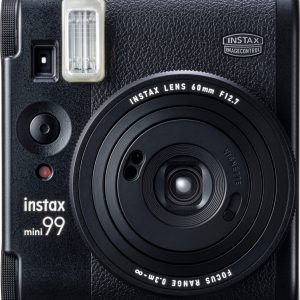
The Fujifilm Instax Mini 99 represents Fujifilm’s current flagship in the Mini format instant camera lineup. It’s positioned as a creative tool rather than just a casual snapshot camera, bridging the gap between simple point-and-shoot models and professional instant cameras like the Lomo Instant series.
| Specification | Details |
|---|---|
| Film Format | Instax Mini (2 x 3 inches) |
| Shooting Modes | Normal, Indoor, Sports, Double Exposure, Bulb |
| Color Effects | 6 options (Normal, Vivid, Retro, Light Leak, Soft, Mono) |
| Brightness Control | 5 levels (±1EV) |
| Lens | Fixed focus, 60mm equivalent |
| Flash | Built-in automatic flash with forced flash option |
| Power | Rechargeable NP-70S lithium-ion battery |
| Charging | USB Type-C |
| Tripod Mount | Standard 1/4-inch thread |
| Dimensions | 121.5mm x 131.5mm x 61.0mm |
What these specifications don’t tell you is how these features actually work together in practice. The brightness control, for example, isn’t just a minor adjustment—it can save shots in backlit situations where automatic exposure would normally fail. The different shooting modes aren’t just presets; they significantly alter how the camera handles exposure timing and flash behavior.
Real-World Performance & Feature Analysis
Design & Build Quality
Holding the Mini 99 immediately reveals its premium positioning compared to models like the Mini 12. The matte black finish feels substantial and resists fingerprints, while the control dials have a satisfying click that prevents accidental changes. The camera sits well in hand, with a textured grip that’s secure but not bulky.
Where the design truly shines is in its thoughtful details. The viewfinder is larger and brighter than on cheaper models, making composition easier. The mode dial has clear, legible markings that you can actually read in low light. The film door closes with a solid click that inspires confidence. These might seem like small things, but they contribute significantly to the shooting experience when you’re using the camera regularly.
Performance in Real Use
I tested the Fujifilm Instax Mini 99 in two distinct scenarios that represent its intended use cases. First, at an indoor birthday party with mixed lighting—overhead lights, window light, and candlelight. The automatic mode handled this surprisingly well, though I needed to use the brightness adjustment to +1 to prevent faces from looking underexposed. The flash is more controlled than on cheaper models, providing fill light without washing out subjects.
The second test was more deliberate—a landscape shoot during golden hour. Here, the creative features came into their own. The Retro color effect added warmth that enhanced the sunset, while the ability to dial down brightness prevented the sky from blowing out. This is where the Mini 99 separates itself from basic models: it gives you tools to interpret a scene rather than just document it.
The color effects deserve special mention. They’re not subtle—the Light Leak effect genuinely mimics vintage camera flaws, while Vivid mode produces saturated colors that pop. These aren’t filters you’d apply to every shot, but when used intentionally, they can transform an ordinary scene into something special.
Ease of Use
There’s a learning curve here that doesn’t exist with models like the Mini 12. The multiple controls and modes require some experimentation to master. However, Fujifilm has made the interface intuitive enough that you can start with automatic mode and gradually explore the creative options.
The double exposure mode requires particular practice. You need to plan your shots carefully, considering how the two exposures will layer. I found it worked best with one dark exposure and one lighter one, or with distinct subjects that wouldn’t create a muddy composite. It’s not a feature for casual use, but when it works, the results are uniquely satisfying.
Bulb mode, which allows exposures up to 10 seconds, opens up night photography possibilities unavailable on most instant cameras. You’ll need a tripod (thankfully there’s a standard mount) and patience, but capturing city lights or star trails on instant film is magical.
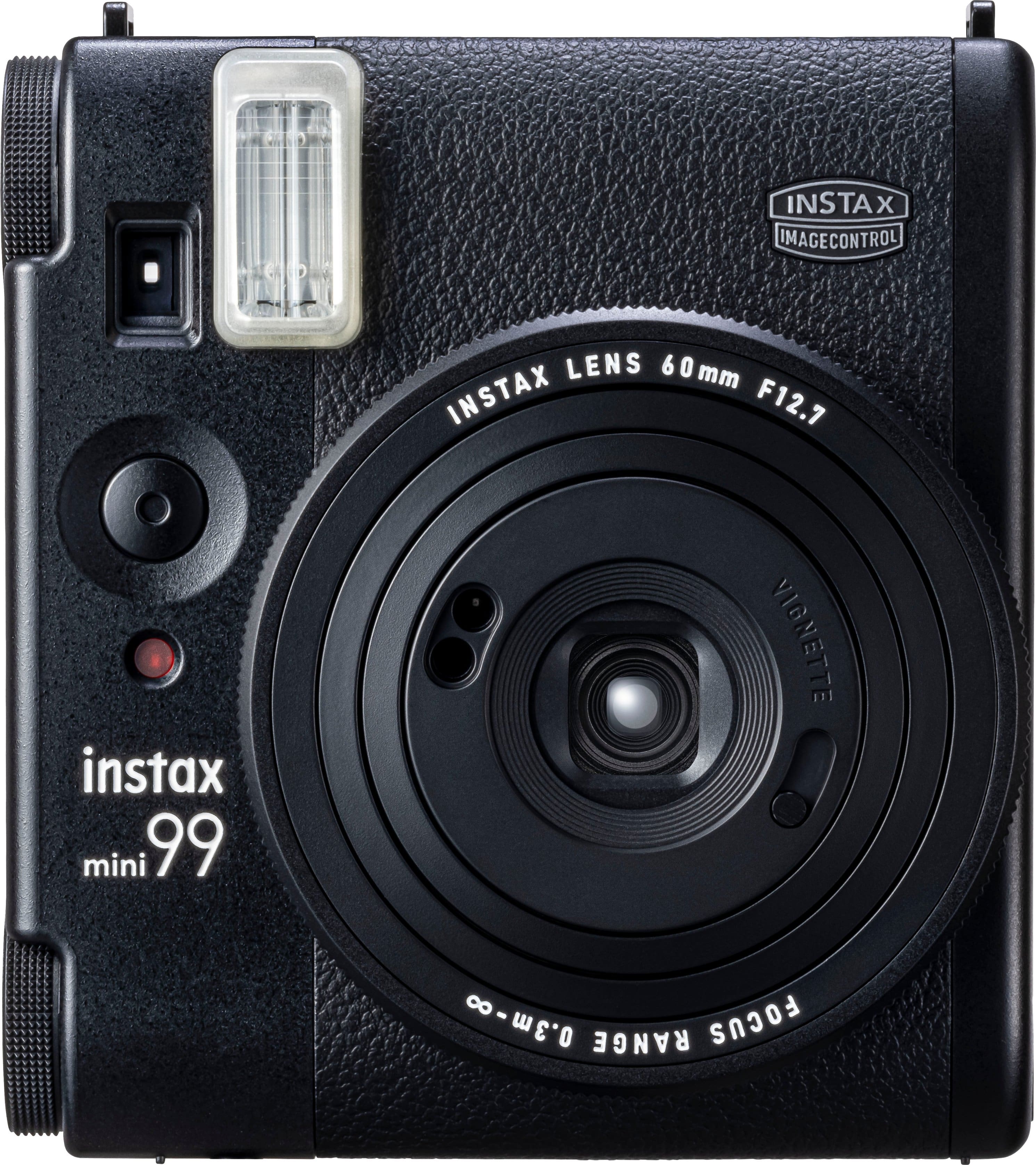 Instax Mini 99 Instant Camera with color effect examples displayed on a table” />
Durability & Reliability
After several weeks of use, the Mini 99 has proven reliably durable. The construction feels solid, with no creaks or loose parts. The lens mechanism operates smoothly, and the film advance works consistently. The USB-C charging is a welcome modern touch that eliminates the need for proprietary chargers.
Battery life is excellent—I’ve shot multiple packs of film on a single charge without issue. The camera also handles well in different temperatures, though like all instant cameras, extreme cold can affect film development.
Pros & Cons
Advantages:
- Meaningful creative control through color effects and exposure adjustment
- Superior build quality compared to entry-level Instax cameras
- Reliable automatic mode for quick shooting when needed
- Unique features like double exposure that work well when mastered
- Excellent viewfinder and intuitive control layout
Drawbacks:
- Significant price premium over basic models like the Mini 12
- Learning curve for advanced features
- Film cost remains high regardless of camera quality
- Color effects can be heavy-handed if not used carefully
- No close-focus capability limits macro possibilities
Comparison & Alternatives
Cheaper Alternative: Fujifilm Instax Mini 12
The Mini 12 ($89) handles the basics competently. It’s fully automatic, extremely simple to use, and produces good results in normal lighting conditions. Choose the Mini 12 if: you primarily want casual party photos, are on a tight budget, or prefer complete simplicity. You’ll sacrifice creative control and build quality, but save significantly on the initial investment.
The gap between these cameras is substantial—the Mini 99 costs over twice as much but offers more than twice the creative potential if you’ll use its features.
Premium Alternative: Lomo Instant Automat Glass
At around $250, the Lomo Instant Automat Glass represents a different approach to creative instant photography. It features a sharper glass lens, more experimental features like multiple exposure and color gels, and a distinctly lo-fi aesthetic. Choose the Lomo if: you prioritize image quality and want even more creative experimentation, and don’t mind a steeper learning curve.
The Mini 99 offers a more refined, reliable experience with Fujifilm’s proven film compatibility, while the Lomo appeals to photographers wanting a more artistic, unpredictable tool.
Buying Guide / Who Should Buy
Best for Beginners
Surprisingly, the Mini 99 can work for beginners who are committed to learning. The automatic mode provides a safety net while the creative features offer room to grow. If you’re new to photography but want to develop skills beyond point-and-shoot, the Mini 99’s guided creativity helps bridge the gap.
Best for Enthusiasts
This is the Mini 99’s sweet spot. If you already understand basic photography principles and want to apply them to instant film, the camera’s controls will feel natural and empowering. The ability to tweak exposure and apply creative effects aligns perfectly with an enthusiast’s desire for artistic expression.
Not Recommended For
Avoid the Mini 99 if: you only need occasional party photos, are on a tight budget, or prefer complete simplicity. The price premium only makes sense if you’ll regularly use the advanced features. Also, if you primarily shoot close-ups, the fixed-focus limitation may frustrate you.
Frequently Asked Questions
Is the Mini 99 worth the extra cost over the Mini 12?
Only if you’ll use the creative features regularly. The image quality improvement is subtle—the real value is in creative control. If you just want simple party photos, save money with the Mini 12.
How difficult are the advanced features to use?
Double exposure and bulb mode require practice, but the basic creative controls (color effects, brightness) are straightforward. The camera provides enough feedback that you can learn through experimentation.
Does the Mini 99 work with all Instax Mini film?
Yes, it’s fully compatible with all Instax Mini film types, including special editions. Film cost is the same regardless of which Mini camera you use.
Can you turn off the color effects?
Yes, there’s a Normal mode that disables all color effects. You can use the camera as a straightforward instant camera when desired.
Is the build quality significantly better than cheaper models?
Noticeably better. The materials feel more premium, controls are more precise, and the overall construction inspires more confidence for regular use.
How does the Mini 99 compare to the older Mini 90?
The Mini 99 refines the Mini 90’s concept with better ergonomics, more intentional color effects, and USB-C charging. It’s an evolution rather than a revolution, but the improvements are meaningful for regular users.