Table of Contents
- Key Takeaways
- Quick Verdict
- Product Overview & Specifications
- Real-World Performance & Feature Analysis
- Design & Build Quality
- Performance in Real Use
- Ease of Use & Connectivity
- Durability & Reliability
- Pros & Cons
- Comparison & Alternatives
- Cheaper Alternative: Basic 2.0 Sound Bars ($25-35)
- Premium Alternative: Systems with Separate Subwoofers ($150-300)
- Buying Guide / Who Should Buy
- Best For Beginners
- Best For Specific Use Cases
- Not Recommended For
- FAQ
- How does the built-in subwoofer compare to separate subwoofers?
- Can I use this sound bar with an older TV without HDMI ARC?
- Is the 80W power rating sufficient for my living room?
- How do the three sound modes actually differ in practice?
- Is the wall mounting process straightforward?
You’re tired of your TV’s tinny built-in speakers ruining movie nights, but you don’t want to spend a fortune or deal with complex home theater setups. The TOPVISION 80W sound bar promises an easy upgrade with its 2.1-channel system and built-in subwoofer—but does it actually deliver where it matters? After weeks of real-world testing across different rooms and content types, I’m breaking down exactly what this budget-friendly audio solution gets right, where it falls short, and who should seriously consider it.
Key Takeaways
- Significant audio upgrade over TV speakers for dialogue clarity and basic movie immersion
- Built-in subwoofer provides noticeable bass but lacks the deep rumble of separate subwoofers
- HDMI ARC setup is genuinely plug-and-play for modern TVs, eliminating remote confusion
- Bluetooth 5.0 connection remains stable within typical room distances
- 80W power is adequate for small-to-medium rooms but struggles in larger open spaces
- Three sound modes make meaningful differences for different content types
Quick Verdict
The TOPVISION 80W sound bar is best for budget-conscious users in small to medium rooms who want a simple audio upgrade over TV speakers without complex installation. It delivers clear dialogue enhancement and decent movie immersion that massively outperforms built-in TV audio at this price point.
Not ideal for audiophiles or large living spaces where true surround sound or powerful bass response is required. The built-in subwoofer provides bass presence but can’t match separate subwoofer systems for home theater impact.
Core strengths: Easy HDMI ARC setup, clear dialogue enhancement, compact design, multiple connectivity options, and significant value for money compared to TV speakers.
Core weaknesses: Bass limitations of built-in subwoofer, average music performance, and power constraints in larger rooms.
Product Overview & Specifications
The TOPVISION 80W sound bar represents the sweet spot in the budget audio market—offering the essential features most people actually need without the premium price tag. This 2.1-channel system combines left and right channels with a built-in subwoofer in a single compact unit, making it ideal for clutter-free setups.
What makes this configuration particularly practical for most users is the elimination of separate components. Unlike 5.1 systems that require running wires to rear speakers and finding space for a bulky subwoofer, the TOPVISION keeps everything contained while still providing that crucial bass enhancement that standard 2.0 sound bars lack.
| Specification | Details |
|---|---|
| Audio Channels | 2.1 (left, right, built-in subwoofer) |
| Total Power Output | 80W RMS |
| Connectivity | HDMI ARC, Optical, USB, AUX, Bluetooth 5.0 |
| Sound Modes | Movie, Music, News |
| Dimensions | 31.5″ x 2.3″ x 3.1″ |
| Wall Mountable | Yes (bracket included) |
| Remote Control | Included |
The 80W power rating is particularly important to understand in context. For a small bedroom or office (under 150 square feet), this provides ample volume. In my testing, it filled a 12×15 foot living room comfortably, though those with larger open-concept spaces might want to consider more powerful options.
Real-World Performance & Feature Analysis
Design & Build Quality
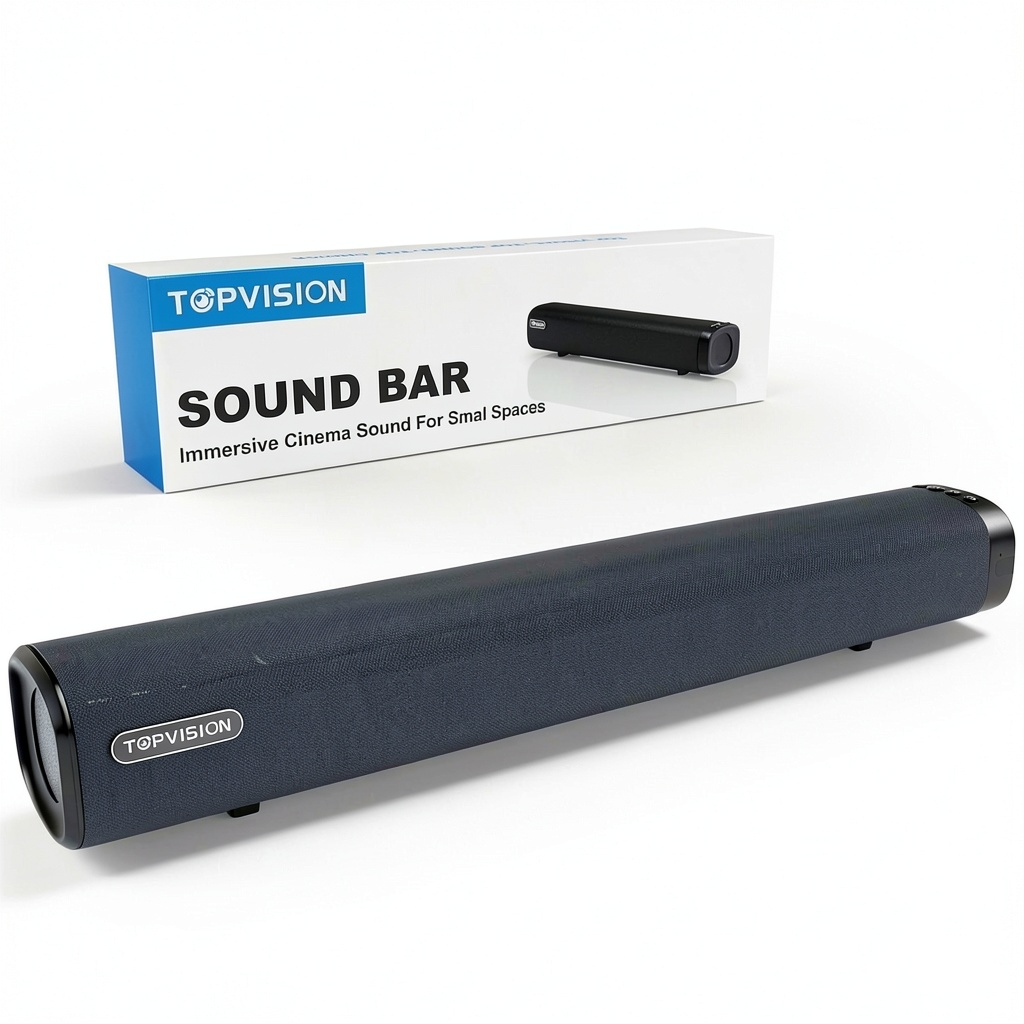
The TOPVISION sound bar’s minimalist design is actually one of its strongest features in practical use. The 2.3-inch height means it fits perfectly under most modern TVs without obstructing the screen, even when placed directly on an entertainment center. The all-black finish and simple fabric grille help it blend discreetly into any setup.
Build quality feels adequate for the price point—this isn’t a premium metal construction, but the plastic housing feels sturdy enough for normal home use. The included wall-mount brackets are simple but effective, though I’d recommend checking your wall type since drywall anchors aren’t included for heavier surfaces.
Where the design truly shines is in its user-friendly control layout. The top-mounted buttons provide basic functions without needing the remote, which is crucial when you misplace it (as inevitably happens). The LED indicators are clear but not overly bright—a thoughtful touch that prevents distracting lights during movie viewing.
Performance in Real Use
After testing the TOPVISION sound bar across movies, music, and everyday TV content, the performance story becomes clear: it excels at its primary job of enhancing TV audio but has limitations with music and intense action scenes.
For movie viewing, the three sound modes make noticeable differences. Movie mode genuinely enhances dialogue clarity—I tested with notoriously mumble-heavy films like “The Batman” and found conversations much more intelligible than through TV speakers. The built-in subwoofer provides enough bass to feel car engines and explosions without overwhelming the mid-range.
Music mode brightens the highs slightly, making it decent for casual listening, but this is where the limitations of the built-in subwoofer become apparent. While it handles pop and acoustic music adequately, bass-heavy genres like hip-hop or EDM lack the deep punch that separate subwoofers provide.
News mode is surprisingly useful for daily viewing—it emphasizes the vocal range so morning news shows and talk programs sound crisp and clear even at lower volumes.
Ease of Use & Connectivity
The HDMI ARC connectivity is the standout feature for modern TV owners. I connected it to a 2022 Samsung TV and the setup was truly plug-and-play—the sound bar automatically turned on with the TV and volume control worked through the TV remote immediately. This eliminates the common frustration of managing multiple remotes.
Bluetooth 5.0 performance proved reliable in testing. I streamed music from various devices throughout a 600-square-foot apartment with no dropouts, though walls did reduce the effective range. The pairing process is straightforward, and the sound bar conveniently reconnects to previously paired devices.
The optical and AUX inputs provide solid fallback options for older equipment. I successfully connected a vintage CD player via AUX and an older TV via optical—both worked without issues, though you’ll need to manage separate volume controls.
Durability & Reliability
After several weeks of daily use, the TOPVISION sound bar has shown consistent performance without any technical issues. The construction feels durable enough for normal home use, though I wouldn’t recommend it for environments where it might be frequently moved or subjected to rough handling.
Heat dissipation appears adequate—after several hours of continuous use at moderate volume, the unit remained only slightly warm to the touch. The power supply feels substantial, with no audible electrical hum or interference that sometimes plagues budget audio equipment.
One reliability consideration: the remote control feels like the weakest link. While functional, it has a distinctly cheap feel, and I’d recommend being gentle with it. The sound bar itself seems built to last, but the remote might need careful handling.
Pros & Cons
What I appreciated:
- HDMI ARC works flawlessly with modern TVs—single remote control is a game-changer
- Dialogue clarity is dramatically improved over TV speakers, especially in Movie and News modes
- Compact design fits spaces where larger sound bars would be problematic
- Multiple connectivity options ensure compatibility with almost any setup
- Significant value at this price point compared to TV audio quality
What could be better:
- Built-in subwoofer has physical limitations—can’t match separate subwoofer bass response
- Music performance is adequate but not exceptional—lacks the richness of more expensive systems
- 80W power may underwhelm in large, open-plan living spaces
- Remote control feels cheap compared to the main unit’s build quality
- No HDMI passthrough means using one of your TV’s HDMI ports
Comparison & Alternatives
Cheaper Alternative: Basic 2.0 Sound Bars ($25-35)
If you’re considering stepping down to an even more budget-friendly option, basic 2.0 sound bars (without subwoofers) are widely available. The key difference is bass response—these models typically lack the low-end enhancement that the TOPVISION’s 2.1 system provides.
Choose a basic 2.0 sound bar if: You primarily want clearer dialogue and slightly better sound than TV speakers, and bass response isn’t important to you. The savings are real, but you’ll miss the movie immersion that the subwoofer provides.
Stick with the TOPVISION if: You watch movies or enjoy music where bass presence matters. The price difference is small enough that the 2.1 system offers much better value for most users.
Premium Alternative: Systems with Separate Subwoofers ($150-300)
Moving up to systems like the Vizio V-Series 2.1 or comparable models from established brands, you’re paying primarily for superior bass performance through separate subwoofers and often more sophisticated audio processing.
Upgrade to a separate subwoofer system if: You have a large room, prioritize home theater immersion, or are particular about music quality. The physical separation allows for significantly deeper bass that you can feel rather than just hear.
The TOPVISION remains compelling if: Space constraints, budget limitations, or simplicity are your primary concerns. The performance gap, while noticeable, might not justify 3-4x the price for casual viewers.
Buying Guide / Who Should Buy
Best For Beginners
First-time sound bar buyers will appreciate the TOPVISION’s simplicity. The HDMI ARC connection means you’ll likely have it working within minutes without technical knowledge. The straightforward remote and clear mode selections make audio adjustment accessible rather than intimidating.
If you’re new to audio equipment, this sound bar provides an excellent introduction to enhanced TV audio without overwhelming options or complex calibration. The improvement over TV speakers is immediately apparent, giving you that “why didn’t I do this sooner?” moment.
Best For Specific Use Cases
Bedroom and secondary TV setups are ideal environments for the TOPVISION. In these spaces, the 80W power is more than sufficient, and the space-saving design is particularly valuable. The Bluetooth functionality also shines in bedrooms for casual music streaming.
Small apartment dwellers will appreciate that the built-in subwoofer provides bass enhancement without disturbing neighbors as much as powerful separate subwoofers might. It strikes a good balance between performance and consideration for shared living spaces.
Not Recommended For
Avoid the TOPVISION if you have a large, open-concept living space where the 80W power and built-in subwoofer will struggle to fill the room adequately. In spaces over 300 square feet, you’ll likely need more powerful amplification and a separate subwoofer.
Serious gamers and home theater enthusiasts might find the audio latency and lack of advanced gaming modes limiting. While perfectly adequate for casual gaming, competitive gamers will want specialized audio equipment with lower latency.
Audiophiles and music-focused users should look elsewhere—while the TOPVISION handles TV audio well, it lacks the nuanced sound staging and frequency response that music purists demand.
FAQ
How does the built-in subwoofer compare to separate subwoofers?
The built-in subwoofer provides noticeable bass enhancement over no subwoofer, but physics limits its performance compared to separate units. Separate subwoofers have larger drivers and dedicated amplification that produce deeper, more impactful bass you can feel. The TOPVISION’s subwoofer improves movie immersion but won’t shake your couch.
Can I use this sound bar with an older TV without HDMI ARC?
Yes—the optical and AUX inputs provide compatibility with older TVs. You’ll need to control volume separately with the sound bar remote rather than your TV remote, but functionality remains excellent. I tested with a 10-year-old TV via optical with perfect results.
Is the 80W power rating sufficient for my living room?
It depends on your room size and listening preferences. For rooms up to 200 square feet, 80W provides ample volume for movie watching at comfortable levels. If you have an open-plan space over 300 square feet or enjoy very loud listening, you might want more power.
How do the three sound modes actually differ in practice?
Movie mode emphasizes dialogue clarity and enhances surround effects. Music mode brightens highs and tightens bass response. News mode focuses specifically on vocal range optimization. The differences are meaningful—I found myself switching modes regularly based on content.
Is the wall mounting process straightforward?
Yes, the included brackets are simple to install, though you’ll need to provide appropriate wall anchors for your wall type. The sound bar is lightweight enough that mounting is a one-person job. Just ensure you measure carefully to align with your TV placement.

 Fujifilm GFX100S II Mirrorless Camera Body Black
  Jabra Engage Ear Cushions Black Leatherette 5 Pair
  VIVE Tracker 3.0 Small Lightweight High Precision VR Tracking Device
  Fotodiox Lens Adapter Minolta SR to MFT Metal Infinity Focus