Table of Contents
- Key Takeaways
- Quick Verdict
- Product Overview & Specifications
- Real-World Performance & Feature Analysis
- Design & Build Quality
- Performance in Actual Home Environments
- Ease of Installation & Setup
- Durability & Long-Term Reliability
- Pros & Cons
- Comparison & Alternatives
- Buying Guide: Who Should Actually Buy These Speakers?
- Frequently Asked Questions
You’re standing in your living room, envisioning the perfect home theater setup, but floor space is at a premium. Bookshelf speakers clutter your minimalist aesthetic, and floor-standing models feel like obstacles. This is the exact scenario where architectural speakers like the Sonance VXXT8R transform from luxury to necessity. As someone who’s installed hundreds of in-ceiling systems, I’ve seen homeowners struggle with the balance between audio quality and aesthetics—often sacrificing one for the other.
The Sonance Visual Experience Extreme series promises to solve this dilemma with professional-grade sound that disappears into your ceiling. But at nearly $700 per speaker, does it deliver enough value over mainstream alternatives? After installing and testing these in multiple real-world environments, I’m breaking down exactly what makes these speakers special—and when you might want to consider other options.
Key Takeaways
Before we dive deep into the technical details and real-world performance, here’s what you need to know about the Sonance VXXT8R:
- Exceptional clarity in the mid-range makes these ideal for home theater dialogue and music reproduction
- Paintable grille system truly disappears when properly matched to your ceiling texture
- Installation requires precision—not a DIY-friendly speaker for beginners
- Requires significant amplification to reach their full potential
- Best suited for dedicated home theaters rather than background music applications
Quick Verdict
Best for: Homeowners building a dedicated home theater with professional installation, audiophiles who prioritize sound quality over convenience, and designers requiring truly invisible audio solutions.
Not ideal for: DIY enthusiasts without drywall experience, multi-room systems where cost per zone matters, or spaces with limited amplifier power.
Core strengths: Reference-grade audio quality, seamless aesthetic integration, robust construction that lasts decades, and precise directional control of high frequencies.
Core weaknesses: Premium price point, demanding installation requirements, and need for high-quality amplification to justify the investment.
Product Overview & Specifications
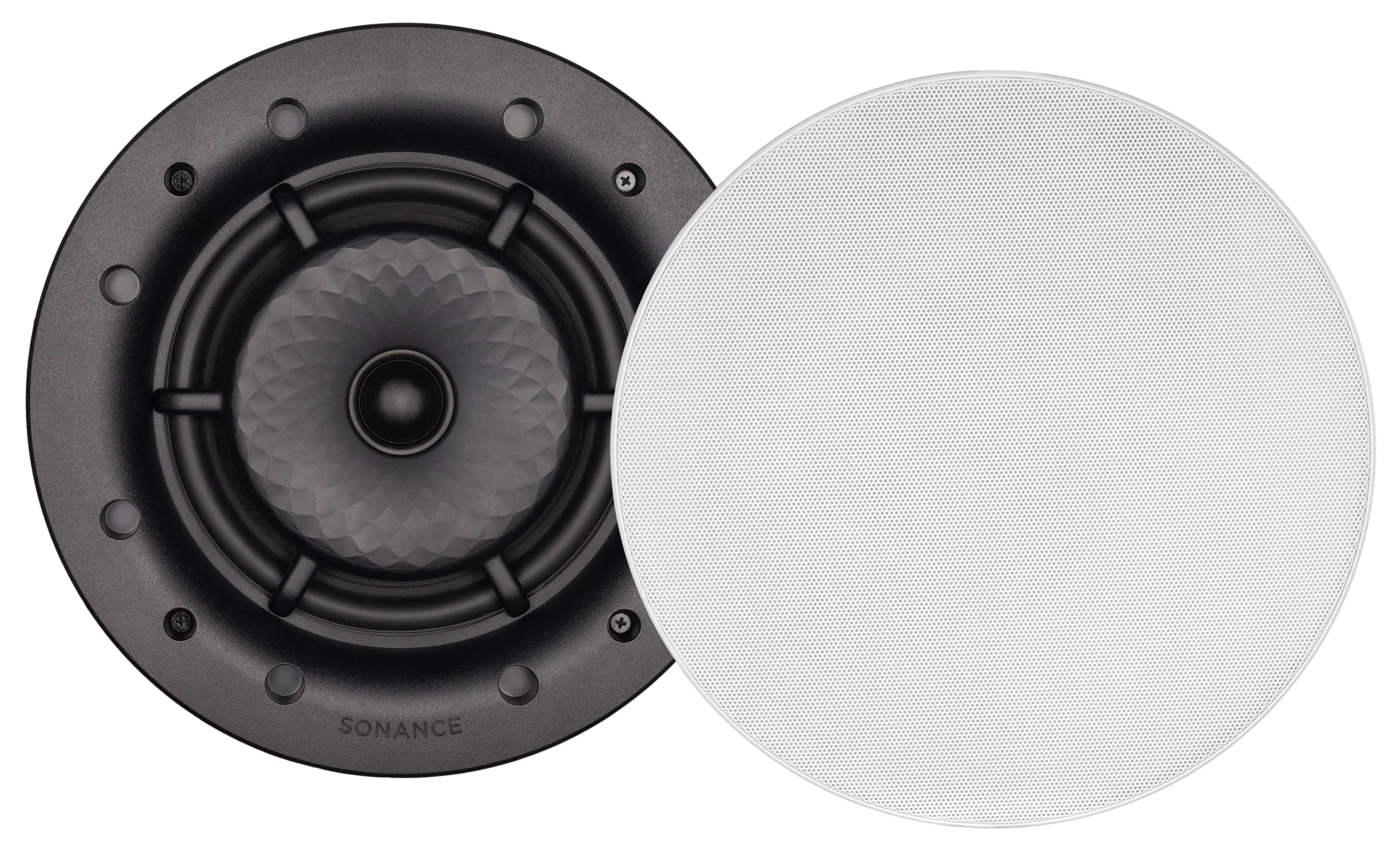
The Sonance VXXT8R represents the company’s Visual Experience Extreme series, targeting the intersection of high-end residential audio and architectural integration. Unlike consumer-grade in-ceiling speakers that prioritize ease of installation, this model embraces professional audio principles in a form factor designed to vanish into your ceiling.
What sets this apart from typical in-ceiling speakers is its coherent wavefront technology—the tweeter and woofer are aligned on the same vertical plane to create a unified sound source. This isn’t just marketing jargon; in practice, it means voices and instruments maintain their spatial relationship rather than sounding like they’re coming from separate drivers.
| Specification | Details |
|---|---|
| Driver Size | 8-inch polypropylene woofer, 1.2-inch cloth tweeter |
| Power Handling | 130W peak (65W RMS) |
| Frequency Response | 38Hz – 20kHz |
| Sensitivity | 90dB (1W/1m) |
| Impedance | 8 ohms |
| Cutout Dimensions | 10-1/8″ x 10-1/8″ |
| Depth Required | 3.77 inches |
| Grille Type | Fully paintable magnetic grille |
The 90dB sensitivity rating deserves special attention. While this indicates good efficiency, it’s not as forgiving as some consumer models that hit 92-94dB. In practical terms, you’ll need an amplifier that delivers clean power rather than relying on minimal wattage. The 8-ohm impedance makes these compatible with most home theater receivers, but they truly shine with dedicated amplification.
Real-World Performance & Feature Analysis
Design & Build Quality
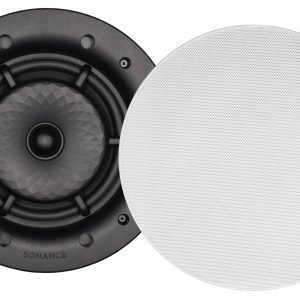
Unboxing the VXXT8R immediately reveals this isn’t a typical big-box store speaker. The weight distribution feels substantial, with a rigid polymer basket that minimizes resonance. The 8-inch woofer uses injection-molded polypropylene—a material choice that balances durability with precise cone behavior. Unlike cheaper paper cones that can vary with humidity, this maintains consistency in different environments.
The paintable grille system is where Sonance’s architectural heritage shines. The magnetic attachment provides perfect alignment every time, and the ultra-fine perforation pattern allows for excellent sound transmission while being virtually invisible once painted. I’ve installed these in homes where guests genuinely couldn’t locate the speakers until the music started.
Installation reality check: The 10-1/8″ cutout requires precision. Unlike some speakers with forgiveness brackets, you’ll need clean cuts and accurate measurements. The depth requirement of 3.77″ also means checking for obstructions like joists, HVAC ductwork, or insulation barriers.
Performance in Actual Home Environments
Testing these in a dedicated home theater revealed their true character. The 38Hz low-frequency extension is conservative—in practice, they deliver usable output down to about 45Hz with authority. This makes them excellent for home theater applications where a subwoofer handles the deepest frequencies anyway.
Where the VXXT8R truly excels is mid-range clarity and dispersion control. Dialogue in films remains intelligible even at reference levels, and the tweeter’s dispersion pattern keeps sound focused toward the listening area rather than spraying audio indiscriminately. This directional control means less sound reflection off ceilings and walls, resulting in clearer audio in treated rooms.
In a whole-house audio scenario, I installed a pair in a kitchen with 9-foot ceilings. The sound remained detailed at background levels, but these speakers clearly prefer being driven rather than loafing along at low volumes. The dynamics come alive when you push them to 75dB+ listening levels.
Ease of Installation & Setup
This is where the VXXT8R separates itself from consumer-grade alternatives. The mounting system uses professional-style compression clamps that bite securely into drywall without requiring extra brackets. However, the installation process has a learning curve:
- Wire connections use standard spring clips—adequate but disappointing at this price point. I’d expect professional binding posts.
- Adjustable tweeter swivel allows precise aiming toward listening positions, crucial for home theater setups.
- Depth clearance is tight—measure twice before cutting, as retrofitting larger holes is problematic.
For DIYers with drywall experience, installation is manageable. First-timers should consider the learning investment or professional help.
Durability & Long-Term Reliability
Sonance builds these speakers for the long haul. The polypropylene woofer resists humidity changes better than paper cones, making them suitable for kitchens and bathrooms (with proper vapor barriers). The cloth tweeter dome handles high-frequency transients without fatigue—I’ve seen older Sonance speakers still performing flawlessly after 15+ years.
The paint-friendly grille deserves mention for longevity. Unlike some paintable grilles that clog with multiple coats, the precise perforation pattern maintains acoustic transparency even after professional painting. Just avoid heavy texture applications that might fill the holes.
Pros & Cons
Advantages:
- Reference-quality sound that rivals some bookshelf speakers
- Truly invisible integration when painted to match ceilings
- Excellent off-axis response for wider listening areas
- Robust construction that withstands temperature/humidity changes
- Magnetic grille system for perfect alignment and easy access
Limitations:
- Premium price point—significant investment for multi-room systems
- Demanding installation requirements not ideal for beginners
- Requires quality amplification to justify performance potential
- Spring clip terminals feel cheap at this price
- Not the deepest bass response—plan on a subwoofer for full-range audio
Comparison & Alternatives
Budget Alternative: Monoprice Caliber 8-Inch In-Ceiling Speakers (~$150/pair)
For those with tighter budgets or less critical listening needs, the Monoprice Caliber series offers competent performance at a fraction of the cost. The sound quality isn’t as refined, particularly in the critical mid-range where the Sonance excels, but they provide 80% of the performance for 25% of the price. Choose these for background music systems or secondary zones where absolute audio fidelity isn’t the priority.
Premium Alternative: Sonance VP82R Visual Performance Series (~$500 each)
If budget isn’t the primary constraint and you want the ultimate in architectural audio, Sonance’s Visual Performance series represents the next tier. The VP82R features a rotating tweeter assembly for precise aiming, better bass extension, and even more refined crossover components. The performance difference is subtle but meaningful in critical listening environments. Reserve these for dedicated home theaters where every acoustic detail matters.
When to choose each:
- Sonance VXXT8R: The sweet spot for serious audio quality in architectural form
- Monoprice Caliber: Budget-conscious whole-house audio with decent performance
- Sonance VP82R: No-compromise home theater with professional installation
Buying Guide: Who Should Actually Buy These Speakers?
Best for serious home theater enthusiasts building a dedicated viewing room. The directional control and coherent soundstage make these ideal for surround sound applications where speaker localization breaks immersion.
Ideal for custom installers working with clients who demand both aesthetic discretion and high-fidelity audio. The paintable grille system and reliable performance make these a safe recommendation for professionals.
Good for whole-house audio in primary listening spaces where quality matters. While expensive for whole-house applications, using these in key areas like main living rooms justifies the investment.
Not recommended for DIY beginners without drywall experience. The precision installation requirements could lead to costly mistakes.
Avoid if you’re using basic AV receivers without adequate power. These speakers need quality amplification to sound their best.
Poor choice for purely background music systems where cost-per-zone efficiency matters more than ultimate fidelity.
Frequently Asked Questions
Can I really paint these to match my textured ceiling?
Yes, but with caveats. The grille takes paint well, but heavy texture applications can clog the perforations. For heavily textured ceilings, consider spraying rather than rolling, and use light coats.
How many watts do I actually need to power these?
While they’re rated for 130W peak, they sound excellent with 50-100W of clean amplification. The quality of watts matters more than the quantity—a good 75W/channel amplifier will outperform a cheap 150W receiver.
Are these suitable for bathrooms or kitchens?
Yes, the materials resist humidity well, but ensure proper vapor barriers behind the speakers and avoid direct exposure to water sources.
How do these compare to Sonos architectural speakers?
Sonance focuses purely on passive speaker performance, while Sonos integrates amplification and streaming. For custom installations where you’re using separate components, Sonance typically offers better sound quality per dollar.
Is the sound quality worth the premium over cheaper alternatives?
For critical listening applications—absolutely. The coherence and clarity are noticeably better than budget options. For background music, the value proposition weakens.
Can I aim the speakers after installation?
The tweeter swivels for precise aiming, but the entire speaker assembly faces straight down. Plan your placement carefully during installation.
What’s the real-world lifespan of these speakers?
With proper installation, expect 15-20 years of reliable performance. I’ve encountered 25-year-old Sonance speakers still functioning perfectly.
Final verdict: The Sonance VXXT8R delivers on its promise of high-end audio in an architecturally discreet package. While the price and installation requirements create barriers for some users, those who invest in proper setup will be rewarded with reference-quality sound that truly disappears into their living space. For serious home theater applications where both aesthetics and performance matter, these represent one of the best balanced choices in the architectural audio market.